
Water Damage Restoration in Mesquite, TX
Water finds the low spots in Mesquite fast. South Mesquite Creek cuts through the middle of town, and when a hard rain hits, the streets near I-635 and Scyene Road can go under in minutes. This page shows what water damage looks like in Mesquite, what we do about it, and what you should do first.
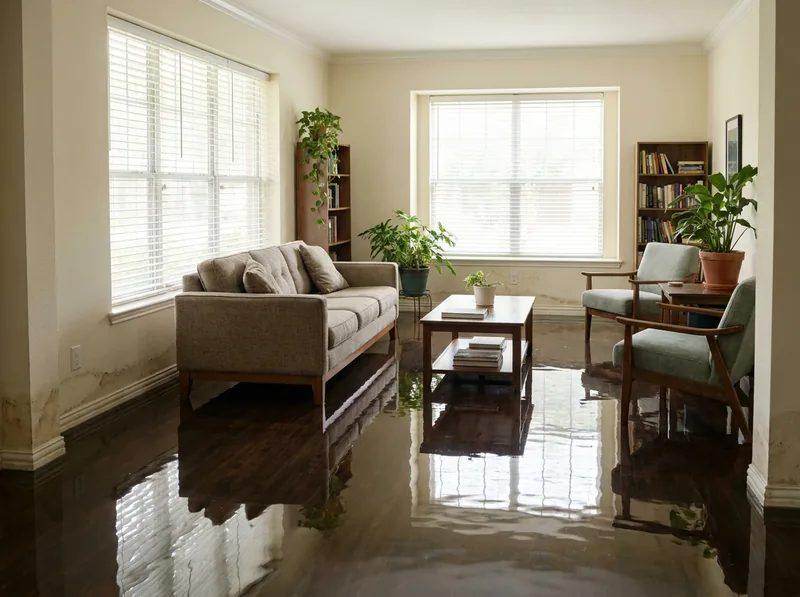
Water damage restoration in Mesquite, TX means stopping the water, pulling out what is standing, mapping moisture through the walls and floors, and drying the home to a measured reading before anything is rebuilt. The work runs in order: extraction, moisture mapping, structural drying with daily readings, cleaning, and rebuild matched to what was there before. We answer around the clock.
Key Facts: Mesquite, Dallas County and Kaufman County
Mesquite sits on the east edge of Dallas. Most of the city is in Dallas County. The east side crosses into Kaufman County.
About 151,000 people live here, by the 2025 Census estimate. The city began in 1873 as a Texas and Pacific Railway depot. It took its name from the mesquite trees that grew along the creek.
The Mesquite Championship Rodeo has run on summer Saturday nights since 1958. The city calls itself the Rodeo Capital of Texas.
Town East Mall anchors the retail core near I-635 and Town East Boulevard. Interstate 30 runs along the north edge. I-635 cuts through the middle. I-20 crosses the south. US 80 heads east toward Forney and Terrell.
Lake Ray Hubbard sits just past the city line to the northeast. Mesquite homes fall into two groups. The middle of the city holds brick ranch houses from the 1960s and 1970s, most on slabs poured fifty and sixty years ago. The east side toward 75181 holds newer two-story homes built in the late 1990s and 2000s.
Why Do Mesquite Homes Flood After Heavy Rain?
Mesquite homes flood after heavy rain because the city is flat, built on Blackland Prairie clay, and cut through by South Mesquite Creek. Rain has nowhere to go fast. The clay swells and holds water at the surface, and the creek rises out of its banks along the low ground near I-635, Scyene Road, and Military Parkway.
On August 22, 2022, more than 10 inches of rain fell in a few hours. Texas DPS closed Interstate 635 at Scyene Road. South Mesquite Creek swept a car off the Loop 635 service road, and the driver was lost. On July 8, 2025, rescuers pulled stranded drivers from water near Military Parkway and Scyene Road. On March 4, 2026, the US 80 and Belt Line underpass closed both ways.
The city has worked on the creek itself. Channel work on South Mesquite Creek between Town East Boulevard and Towne Centre Drive was built to cut erosion and pull school facilities out of the floodplain. The bridge on North Mesquite Drive was replaced to move more water. Even so, the low crossings still fill first in a hard storm.
The same clay that holds rain at the surface also moves under Mesquite slabs. It swells in wet seasons and shrinks in drought. That movement stresses the pipes buried under the slab, and it opens hairline cracks where water can sit. A home that never saw creek water can still take on water from a slab leak the clay helped cause. The FEMA flood maps for the Kaufman County side of Mesquite took effect on January 12, 2023.
Call First: A Mesquite Emergency Starts at the Creek or the Street
Call (469) 548-7594 first. Tell us the address, whether water is still coming in, and how deep it is. A crew heads out with truck-mounted extractors, pumps, and moisture meters.
Creek water and street water are not clean water. Do not wade through it. It carries fuel, sewage, and debris from the road. Keep children and pets out of it. If water reaches an outlet or a panel, stay out of the room and cut power from a dry panel if you can do it safely.
Most Mesquite emergency calls start one of three ways. A hard rain pushes South Mesquite Creek over its banks and water comes in under the doors near Scyene Road. A supply line lets go in a 1960s brick ranch in Town East Estates. Or a washer hose splits upstairs in a two-story home near Creek Crossing and the ceiling below starts to sag.
We pull the standing water first. Then we check every room the water could have reached, not just the room you can see. Water runs under baseboards and vinyl plank and hides in wall cavities. The moisture meter finds it. The readings go into a written log you can hand to your adjuster. See emergency water damage and water extraction for the full service.
Creek Water or Street Water: Flood Cleanup in Mesquite
Flood water in Mesquite usually comes from the creek or from the street, not from a pipe. That changes the job. Creek water is dirty water. It leaves silt on the floor, soaks the bottom of the drywall, and gets under flooring where a mop will never reach it.
We pull the water out, then we pull out what cannot be saved. Wet drywall at the bottom of a wall usually comes out. Wet carpet pad usually comes out. The slab and the framing get cleaned and dried. Hard surfaces get washed and disinfected. Then the air movers and dehumidifiers go in, and the drying runs until the meter readings fall to dry.
Homes near South Mesquite Creek take the worst of it. The low ground around North Mesquite Drive, Town East Boulevard, and the Loop 635 service road floods first, and it floods again in the next storm if the drains are still full of silt. If your home sits in that low ground, call while the water is still there. Every hour it sits, it wicks higher into the walls. See flood damage restoration.
Fifty-Year-Old Copper: Burst Pipes in Mesquite Brick Ranches
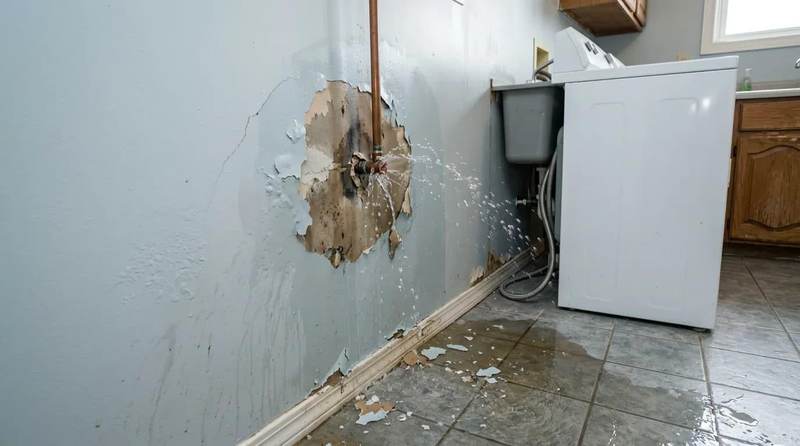
Most Mesquite burst pipes are old pipes. The brick ranches in the middle of the city still run on copper supply lines put in fifty and sixty years ago. Copper that old thins at the joints. A hard freeze finds the thin spot. The pipe splits in an outside wall, in the garage, or in the attic, and the water runs until someone shuts it off.
Slab lines fail a different way. The Blackland Prairie clay under the slab swells when it is wet and shrinks when it is dry. That slow movement bends the lines buried in the slab. A warm spot on the floor, a water bill that keeps climbing, or vinyl plank that starts to buckle usually means a slab leak. Your plumber repairs the line. We dry the slab, the walls, and the flooring around it.
Shut the water off at the main if you can find it. In most Mesquite ranches the main sits near the street or on the side of the house by the hose bib. Open a low faucet to drain the lines. Take photos of the wet rooms before you move anything. Then call (469) 548-7594. See burst pipe water damage.
A Slow Leak Behind a Mesquite Wall: Mold You Smell Before You See
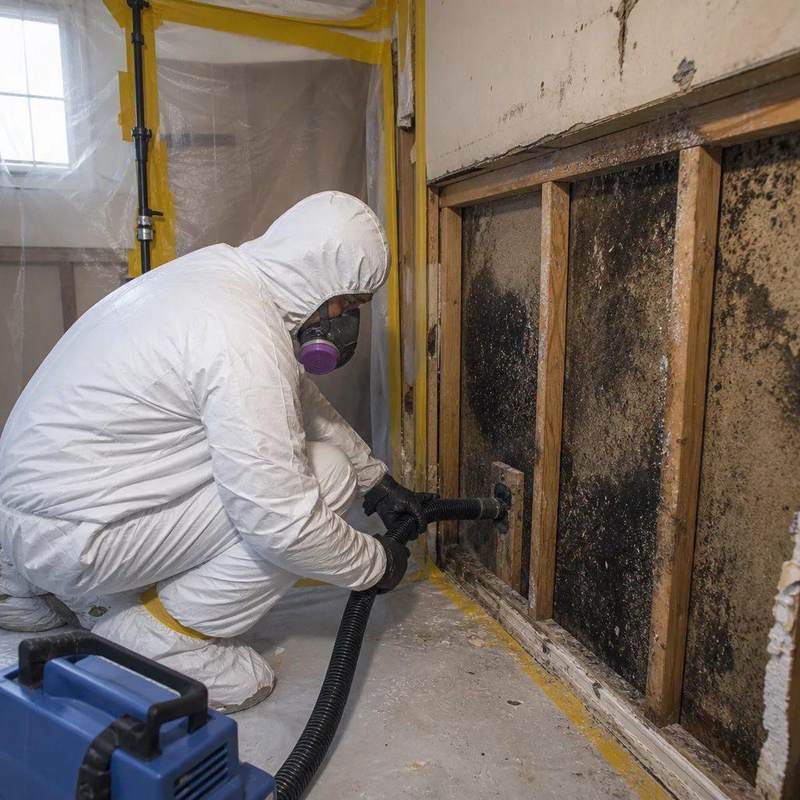
Mold starts fast in a Mesquite home. Wet drywall and insulation can grow mold within 24 to 48 hours. A slow leak behind a wall can grow it for weeks before anyone sees a stain. The first sign is often a smell, not a spot.
Two Mesquite home types hide mold in different places. In the 1960s and 1970s slab ranches, it hides behind the baseboards and under the vinyl plank, where a slab leak wets the floor from below. In the newer two-story homes on the east side, it hides in the ceiling below an upstairs bathroom, where a slow drip wets the insulation from above.
We find the moisture first. A meter and a camera show how far the wet runs. Then we set containment around the wet area, pull out the wet drywall and insulation, clean the framing, and dry it to a reading. The leak gets fixed before the wall goes back together, or the mold comes back. See mold remediation.
Sewage Water in a Mesquite Home: What Comes Out, What Gets Cleaned
Sewage water is Category 3 water. That means it carries bacteria and must be removed, not dried in place. Anything soft that touched it gets thrown out. Hard surfaces get cleaned and disinfected. Then the room gets dried.
Mesquite sees sewage backups in two places. The older mid-century neighborhoods still run on sewer laterals that are fifty and sixty years old. Roots get in, the line bellies, and a heavy rain pushes the system past what it can carry. The backup shows up in the lowest drain first.
Stop using every sink, toilet, and washer on the same line. Keep everyone out of the wet room. Get a plumber to clear the line and call us for the cleanup at the same time. If sewage reached a kitchen, a bathroom, or a room where children play, do not try to clean it yourself. See sewage cleanup.
Drying a Mesquite Home So It Stays Sound
Drying is the part of the job that decides whether the home stays sound. We set air movers to push dry air across wet surfaces and dehumidifiers to pull the moisture out of the air. We take moisture readings every day. The job is done when the readings hit dry, not when the floor feels dry to the touch.
A Mesquite slab holds water longer than most people expect. Concrete pulls water in and lets it out slowly. Vinyl plank over a wet slab traps it. We lift the flooring when the meter says the slab is wet underneath.
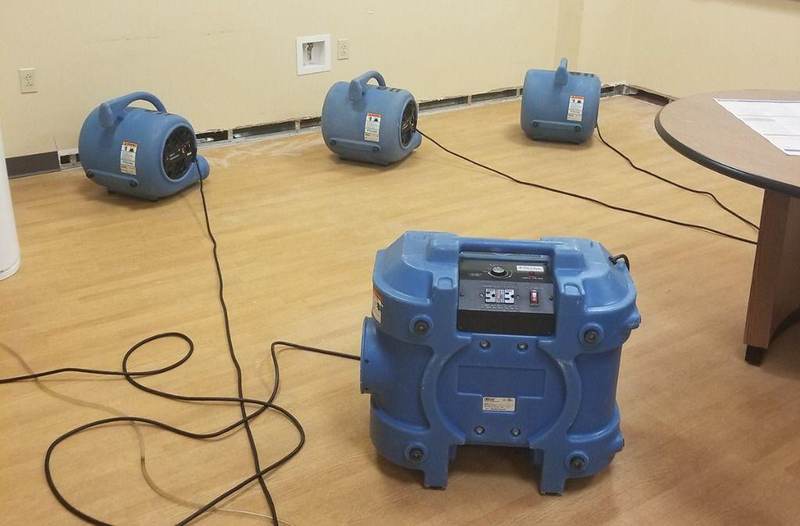
Drying time depends on the material, the water type, and how long the water sat. The table below shows what Mesquite homeowners usually see. The readings decide in every case.
| Material | What we do | Usual drying window |
|---|---|---|
| Drywall, clean water | Air movers and dehumidifiers, baseboards lifted | 3 to 5 days |
| Concrete slab | Flooring lifted, slab dried to a reading | 5 to 7 days |
| Hardwood floors | Surface water pulled, drying mats set, readings checked daily | 5 to 10 days |
| Carpet pad, clean water | Pad pulled and replaced, carpet dried in place where it can be saved | 2 to 4 days |
| Ceiling and insulation | Wet insulation removed, cavity dried open | 4 to 7 days |
See structural drying for the full process.
The First Visit to Your Mesquite Home: What We Do First
We stop the water at the source or show you the shutoff. We pull out the standing water with truck-mounted extractors. We check every room with a moisture meter and a camera.
We lift baseboards and flooring where the meter says water is trapped. We set the drying equipment and log the first readings.
We photograph the source, the wet rooms, and the readings as we go. That file goes to you and to your adjuster. Nothing gets rebuilt until the readings say the structure is dry.
Mesquite ZIP Codes We Serve: 75149, 75150, and 75181
We work across all of Mesquite, in ZIP codes 75149, 75150, and 75181. The 75185 and 75187 ZIP codes are post office boxes, not street addresses.
In Town East Estates, the brick ranches near Town East Mall take burst pipes and slab leaks. In Skyline, Falcon's Lair, and Indian Trails, the same mid-century homes sit on the same moving clay. In Creek Crossing Estates, Park at Creek Crossing, and Solterra on the east side, the newer two-story homes take upstairs leaks that wet the ceiling below.
Historic Downtown Mesquite, south of US 80 along the railway, holds older commercial buildings and early houses near Main Street. The retail strips along Town East Boulevard and the offices near I-635 take sprinkler discharges and roof leaks. The warehouses on the south side along I-20 take roof leaks across wide flat roofs.
We also help homeowners in Rowlett, Rockwall, Sunnyvale, and Balch Springs. Garland and Dallas sit right next door.
Questions Mesquite Homeowners Ask Us
Does South Mesquite Creek flooding reach homes, or just the roads?
Both, but the roads go first. The low crossings near I-635, Scyene Road, and Military Parkway fill in a hard storm. Homes on the low ground near the creek take water under the doors when the creek rises past its banks, as it did on August 22, 2022. If your home sits near the creek, check your flood zone and call while the water is still there.
My Mesquite house was built in the 1960s. Why does that matter for water damage?
Three reasons. The copper supply lines are fifty and sixty years old and thin at the joints. The slab sits on Blackland Prairie clay that moves with wet and dry seasons and stresses the lines under it. And the sewer lateral outside is the same age, so roots and bellies back it up in a heavy rain. Old pipes, moving clay, and old sewers add up to more leaks.
How long does drying take in a Mesquite slab home?
Usually 3 to 5 days for clean water in drywall and framing. A wet concrete slab takes longer, often 5 to 7 days, because the slab holds water and lets it out slowly. The moisture readings decide. We check them every day and the equipment stays until the slab reads dry.
Can you come tonight to Mesquite?
Yes. Call (469) 548-7594 any time. Tell us the address, whether water is still coming in, and how deep it is. A crew is dispatched right away.
What should I do first if water is coming in under my door?
Push towels against the door to slow it. Move rugs, boxes, and electronics off the floor. Take photos of the water and where it came in. If the water is from the street or the creek, do not wade in it. Then call (469) 548-7594 and tell us how fast it is rising.
Do you work in Rowlett and Rockwall too?
Yes. We cover Mesquite and the towns right around it, including Rowlett, Rockwall, Sunnyvale, and Balch Springs.
Does my homeowners policy pay for creek flood damage?
General information only, and policies vary. A sudden pipe leak is usually covered. Rising creek water is usually not covered by a standard homeowners policy and needs separate flood cover. Check your policy and call your agent. Start drying right away either way, and keep the photos and moisture logs for the claim.
Get Help in Mesquite
Tell us what you are dealing with. For immediate help, call us.
Water damage in Mesquite moves fast, and it moves twice: once from the creek and the street, and once from the old pipes and moving clay under the slab. We pull the water, map the moisture, dry the home to a measured reading, and hand you the records. Call (469) 548-7594 any time, anywhere in Mesquite, in ZIP codes 75149, 75150, and 75181.
Water in Your Mesquite Home Right Now? Call (469) 548-7594
Shut off what you can, take photos, and call. A crew heads to your home right away.