
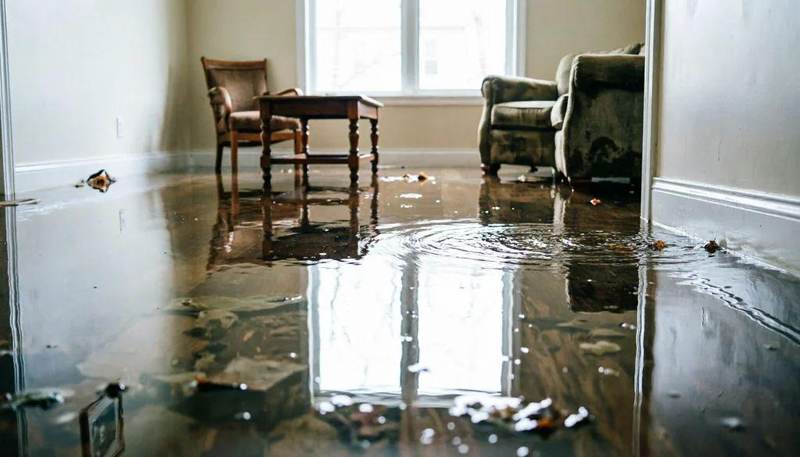
Water Damage Restoration in Bertram, TX 78605
Burnet County Storm Recovery, Historic Building Cleanup and Hill Country Property Drying
Bertram sits on Highway 29 in eastern Burnet County where the Hill Country begins to flatten out a town with limestone buildings from the 1890s standing beside new ranch homes on five-acre tracts. Straight-line winds of 75 mph on March 22, 2021 collapsed part of the 1905 A.B. McGill general store and a June 2014 tornado brought 125 mph winds through town. Between spring supercells, aging plumbing in century-old stone structures and flash flooding in Hill Country creek draws, Bertram properties need water damage restoration built for the specific materials and terrain of this part of Texas.
Bertram Water Damage at a Glance
| Detail | What to Know |
|---|---|
| ZIP code | 78605 |
| County | Burnet County, eastern side |
| Location | Highway 29 corridor, ~55 miles northwest of Austin |
| Property types | Historic limestone/stone commercial buildings (1890s-1920s), original town homes, newer ranch-style homes on acreage, manufactured homes |
| Storm history | June 2014 tornado (125 mph), March 22, 2021 straight-line winds (75 mph, collapsed 1905 A.B. McGill store) |
| Common causes | Storm and wind damage, aging plumbing in historic structures, flash flooding in creek draws, freeze damage to exposed lines, roof failures on stone buildings |
| Wastewater | Municipal sewer in town; septic systems on acreage |
| Emergency response | 24/7/365 call (469) 548-7594 |
How We Help in Bertram

Homes
- Emergency water damage and water extraction
- Structural drying with daily moisture readings
- Roof leak and storm water damage
- Burst pipe water damage, including wells and outbuildings
- Sewage cleanup and mold remediation

Downtown businesses
- Commercial water damage for shops, offices, and older buildings on Highway 29 and Grange Street
Historic Downtown Bertram Stone Walls, Shared Walls and Century-Old Plumbing
Bertram's downtown along Highway 29 retains several original limestone and native-stone commercial buildings from the late 1800s and early 1900s. These buildings were constructed with thick load-bearing stone walls, plaster interiors, wooden floor joists set into stone pockets, and flat or low-slope roofs with minimal drainage pitch.
Water damage in a historic stone building behaves nothing like water damage in a modern frame house.
Limestone Absorbs and Holds Moisture for Weeks
Native limestone is porous. When water enters through a roof failure, broken window or plumbing leak, the stone absorbs moisture deep into the wall. Surface drying does nothing the moisture sits inside the stone, wicking upward through capillary action and feeding mold growth on the interior plaster surface. Drying historic stone walls requires controlled dehumidification over days or weeks, with moisture monitoring at multiple depths. Aggressive heat drying cracks the mortar joints and damages the stone.
Shared Walls Between Adjoining Buildings
Several downtown Bertram buildings share party walls a single stone wall serving as the boundary between two businesses. Water from a roof leak on one side migrates through the shared wall into the adjoining building. The owner next door may not know their wall is wet until plaster starts crumbling or mold appears on the interior surface. Both sides of a shared wall must be assessed and dried simultaneously.
Original Plumbing in 100-Year-Old Buildings
Buildings that have been in continuous use since the early 1900s have had multiple generations of plumbing installed through and around the original stone structure. Galvanized supply lines corrode from the inside over decades. Cast-iron drain lines crack and separate at joints. Replacement lines were sometimes routed through the stone wall itself, creating pathways for water to travel when a connection fails. A plumbing failure behind a stone wall can saturate the entire wall section before any exterior sign appears.
Flat Roof Drainage on Commercial Buildings
Most of downtown Bertram's commercial buildings have flat or nearly flat roofs with internal drains or scuppers. Decades of patching, reroofing and ponding have compromised drainage. A blocked internal drain during a spring thunderstorm creates a pool on the roof membrane, and the water finds the lowest point usually an old penetration, a failed seam or a deteriorated parapet cap. The leak drips onto ceiling joists and down through interior walls.
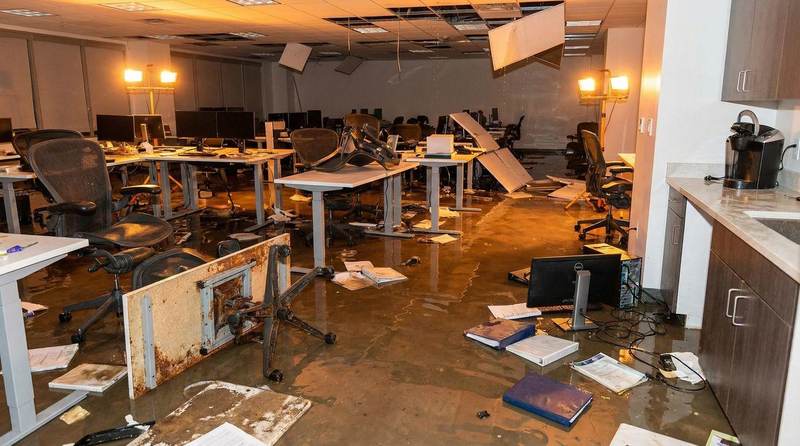
The March 2021 Straight-Line Winds and the June 2014 Tornado
Bertram has taken two significant hits in the last decade, and both times the wind opened buildings that rain then filled.
March 22, 2021 75 mph straight-line winds. A severe thunderstorm with straight-line winds collapsed part of the 1905 A.B. McGill general store on Highway 29. The winds peeled metal roofing, broke windows, toppled trees onto structures and sent debris through building envelopes across eastern Burnet County. Rain entered every opening the wind created.
June 2014 EF-2 equivalent tornado, 125 mph winds. This tornado tracked through the Bertram area with winds strong enough to remove roofs, destroy outbuildings and overturn mobile homes. Homes and businesses that lost roof sections were exposed to days of rain before temporary repairs could be completed.
The storm damage sequence is identical regardless of wind speed:
- Wind opens the building envelope shingles stripped, windows shattered, metal panels torn, walls breached
- Rain enters through every opening before tarps or board-ups go on
- Insulation saturates and holds moisture against roof decking, ceiling joists and wall framing
- Water travels through gravity and capillary wicking into floors, cabinets and interior finishes
- EPA guidelines confirm mold colonization begins within 24 to 48 hours on wet organic materials in Texas humidity
Insurance note: Storm claims in Burnet County carry a separate wind and hail deductible on most homeowners and commercial property policies. Rain entering through wind damage is typically covered. Rising water from creek flooding requires a separate NFIP flood policy.
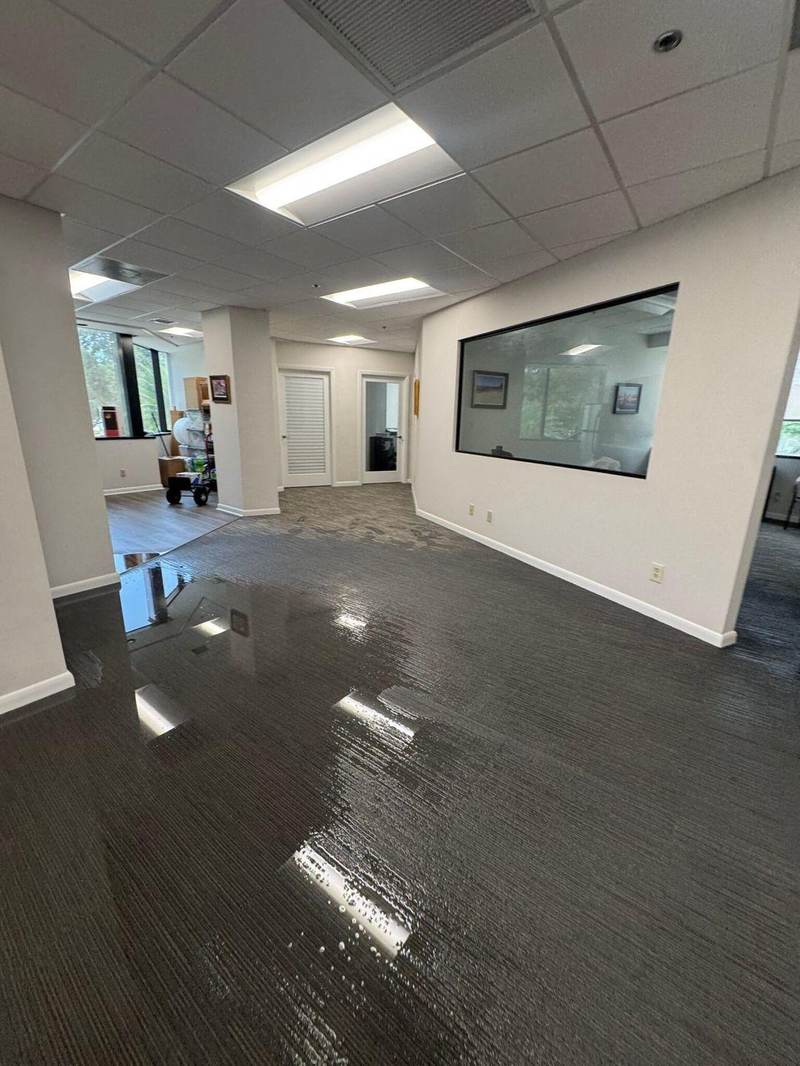
Hill Country Properties Flash Flooding, Creek Draws and Ranch Homes on Acreage
Bertram sits at the eastern edge of the Texas Hill Country, where thin topsoil over limestone bedrock means rainwater runs off fast. The creeks and draws around Bertram can go from dry to dangerous in under an hour during a spring or fall thunderstorm.
Flash Flooding in Creek Draws and Low-Water Crossings
The Memorial Day 2015 Wimberley flood when the Blanco River rose over 40 feet overnight demonstrated what Hill Country flash flooding does to structures. Bertram's terrain produces the same phenomenon on a smaller scale: narrow limestone draws funnel rainwater from wide catchment areas into concentrated flows that overwhelm low-water crossings and flood structures built in or near draws.
Floodwater in the Hill Country carries limestone silt, clay and agricultural runoff. It is classified as IICRC S500 Category 3 contaminated water regardless of its appearance. All porous materials contacted by floodwater carpet, pad, lower drywall, insulation, particleboard cabinets are removed. Hard surfaces are cleaned with EPA-registered antimicrobials.
Ranch Homes, Metal Buildings and Manufactured Homes on Acreage
Newer properties around Bertram include site-built ranch homes, barndominiums, metal shop buildings with living quarters and manufactured homes on permanent foundations. Each handles water differently:
- Site-built ranch homes on slabs share the same failure profile as new construction elsewhere PEX fitting failures, AC condensate line clogs, water heater failures and ice-maker line bursts within the first five to ten years
- Barndominiums and metal buildings have open floor plans where a single supply line failure sends water across the entire slab. Interior framed walls sit on the slab and soak from the bottom plate up. Metal roof fastener washers deteriorate and let rain in a drip at a time
- Manufactured homes on piers have supply and drain lines running through the crawl space with minimal insulation against freezes. A frozen supply line under a manufactured home may not show until the thaw
Well Water and Septic Systems on Rural Bertram Properties
Properties outside Bertram city limits often rely on private wells and septic systems. A well pump failure can flood the pump house, utility room or crawl space. Septic backups after extended rain push Category 3 black water through the lowest fixtures. Full contaminated-water cleanup protocols apply removal of all contacted porous materials, disinfection of hard surfaces, HEPA filtration during remediation and structural drying with LGR dehumidifiers.

Freeze Damage in Bertram When Hill Country Winters Crack Old Plumbing
Bertram is far enough into the Hill Country that hard freezes arrive most winters, and Winter Storm Uri in February 2021 hit Burnet County especially hard. The town's mix of old and new plumbing creates a wide range of freeze vulnerabilities.
Historic buildings with original plumbing. Galvanized supply lines running through exterior stone walls have zero insulation value from the stone itself stone conducts cold directly to the pipe. These lines freeze before any modern pipe in town.
Supply lines under pier-and-beam homes. Older Bertram homes on piers have exposed water lines in the crawl space that freeze when temperatures drop below 20°F for more than four hours. The pipe splits at the weakest point, usually a fitting or a section thinned by corrosion.
Manufactured homes with belly-board insulation. The flexible belly board under manufactured homes traps cold air around the plumbing when it sags or tears. Ice forms in the supply lines, and the burst flood fills the belly cavity before water appears inside the home.
Post-freeze response. After a freeze event, the damage appears at the thaw. Emergency water extraction starts with shutting off the main supply valve, then removing standing water with truck-mounted extractors. Wall cavities are opened at the base to check for hidden saturation. Structural drying with LGR dehumidifiers and air movers runs until pin meter readings confirm the framing is at or below 15 percent moisture content.
Mold in Bertram Why the Hill Country Climate Accelerates Growth
Bertram's location in the Hill Country means summer humidity regularly exceeds 70 percent, and spring rainfall keeps outdoor moisture levels high for weeks. The EPA confirms mold colonization begins within 24 to 48 hours on wet organic materials, and in Bertram's climate those 48 hours produce more growth than the same period in drier parts of Texas.
Texas mold law applies at 25 contiguous square feet. Under TDLR Chapter 1958, mold remediation exceeding 25 contiguous square feet requires a licensed mold remediator and a separate licensed mold assessor. The assessor cannot be employed by the same company performing the remediation. A mold inspection identifies the species present common Hill Country species include Aspergillus, Penicillium, Cladosporium and Stachybotrys (black mold) and maps the affected area before remediation begins.
Stone buildings hold moisture that feeds mold for months. In Bertram's historic downtown buildings, mold often grows behind plaster on the interior face of the stone wall, invisible until the plaster bubbles, cracks or develops a musty odor. Removing the plaster exposes the colonized stone surface, which must be cleaned with antimicrobial agents and dried before new plaster is applied.
Questions Bertram Property Owners Ask When Water Is Spreading Through the Building
A roof leak in a historic stone building is fundamentally different because the stone walls absorb and hold the water. In a modern frame building, water runs down studs and collects at the bottom plate. In a stone building, water wicks into the limestone through capillary action, saturating the wall from the inside. Drying a wet stone wall takes controlled dehumidification over days to weeks rather than the three-to-five-day timeline for a framed wall. Aggressive heat drying cracks century-old mortar joints.
Yes. Any water that entered the property from a creek, draw or overland flow is classified as IICRC S500 Category 3 contaminated water regardless of how clear it appears. Hill Country floodwater carries limestone sediment, agricultural runoff, septic leachate from upstream properties and animal waste. All porous materials the water contacted must be removed, hard surfaces disinfected and the structure dried with professional flood damage restoration protocols.
Yes, with the right approach. Historic stone and masonry buildings require restoration methods that preserve the original materials and construction techniques. Water damage restoration in a historic structure focuses on removing moisture without damaging the stone, mortar or original finishes. This means slower, controlled drying rather than the aggressive approach used in modern construction. A structural engineer should assess load-bearing walls before any demolition or reconstruction.
Yes. Burnet County sits in the convergence zone where Gulf moisture meets dry air from the west, producing severe thunderstorms from March through June most years. The National Weather Service Storm Prediction Center identifies this corridor as having elevated severe-storm probability annually. The question is not whether storm damage will occur again but whether the property is prepared with current roofing, secured openings and adequate insurance coverage including wind and hail deductibles.
Stop using all plumbing immediately. Every flush, every faucet and every drain sends more water into the already-overloaded septic system and pushes more sewage back into the house. Keep children and pets out of the affected area. Do not attempt to mop or vacuum sewage with household equipment. Call for professional sewage cleanup Category 3 black water requires removal of all contacted porous materials, EPA-registered disinfection and HEPA-filtered air scrubbing to capture aerosolized pathogens.
Bertram and Nearby Burnet County Communities We Serve
Our crews respond across eastern Burnet County and the surrounding Hill Country:
Burnet County: Bertram, Horseshoe Bay, Burnet, Marble Falls - call to confirm coverage
Llano County: Llano
Travis County / Hill Country: Spicewood, Jarrell
Williamson County: Georgetown, Pflugerville
For the full list of Texas communities we serve, visit our Areas We Serve page.
Stone Walls Don’t Dry on Their Own Call Before the Damage Spreads
Whether it is a roof leak in a century-old downtown building, a burst pipe in a ranch home on Highway 29, flash flooding in a creek draw or a septic backup on rural acreage, water damage in Bertram requires restoration that respects the materials, the terrain and the climate of eastern Burnet County.
Get Help in Bertram
Tell us what you are dealing with. For immediate help, call us.